Before the WAF signature propagates and before the patch reaches every server, what can we do on the endpoint side?
Executive Summary
On July 17, 2026, a critical pre-authentication remote code execution (RCE) vulnerability was disclosed in WordPress Core under the identifier CVE-2026-63030. Dubbed "wp2shell" by the security community, the flaw stems from chaining a route confusion in the WordPress REST API's batch endpoint with a SQL injection. The attacker needs no credentials, no account, and no installed plugin — even a stock installation is affected. Affected versions fall in the 6.9.0 - 7.0.1 range; patched versions are 6.9.5, 7.0.2, and 7.1 Beta 2. Rapid7 expects a public PoC to be released shortly. With the wp2shell-fast automation tool circulating on forums, the vulnerability has strong potential to turn into an "internet-scale mass shell" opportunity for initial access brokers (IAB) and ransomware operations. In this post we cover the technical internals of the vulnerability, what needs to be done at which layers, and 5 BIOC rules plus 1 retrospective hunt query that can be deployed on the Cortex XDR side.
What Does the Vulnerability Enable?
The /wp-json/batch/v1 endpoint of the WordPress REST API is a feature that matured with WordPress 6.9. Its purpose is to execute multiple REST calls sequentially within a single HTTP request — a performance convenience for developers. The vulnerability arises from a route confusion in this batch handler's internal routing, which allows parameter validation for sub-requests to be bypassed.
As a result of the route confusion, WP_Query parameters normally considered safe (in the publicly disclosed details, particularly author__not_in) reach the query in an unexpected context without adequate sanitization. This is the first link in the SQL injection chain. The fact that class-wp-query.php is among the core files modified in the patch supports this assessment. The SQL injection begins with database read capability and, in the final link of the chain — the part researchers intentionally delayed to give defenders time to patch — reaches code execution.
The vulnerability has only one prerequisite: if a persistent object cache (Redis/Memcached based) is not enabled, the vulnerable code path can be triggered. Installations with object cache active provide a temporary hardening, but it does not replace the patch. It only narrows one exploitation path.
The practical flow of the attack is as follows: sites in the vulnerable version bands (6.9.x / 7.0.x) are mass-identified with engines like FOFA or Shodan. Pre-auth RCE is triggered against the batch endpoint with a single request, and a webshell is typically dropped into the wp-content/uploads directory or a theme directory. Then, persistence is established via the webshell using a fake mu-plugin, cron job, or malicious code embedded in wp_options. DB credentials inside wp-config.php on the same server, backups, and internal network access are mapped out. Customer databases are exported for exfiltration and, in the final step, the web root directory is encrypted. Since WordPress installations are often co-located with the DB, backups, and sometimes the internal network on the same machine, a single shell foothold is sufficient for double extortion.
Why WAF and Patching Come First
The most effective way to stop wp2shell is to upgrade to a current version. Even though the auto-update channel has initiated a forced update in managed environments, automatic updates are disabled in most enterprise WordPress installations — especially on sites using customized themes or plugins. Verifying the actual version with wp core version is critical.
The second layer is virtual patching on the WAF or reverse proxy side. For sites without a legitimate batch API integration, blocking the /wp-json/batch/v1 endpoint to return 403 directly is sufficient. The frequently used bypass variants rest_route=/batch/v1 (query string) and its encoded counterpart rest_route=%2Fbatch%2Fv1 must not be forgotten either. All three variants can be closed with a single rule on ModSecurity, Cloudflare, or a cloud WAF.
The third layer is hardening. Disabling PHP execution under wp-content/uploads/ at the Nginx/Apache level prevents webshells from being executed even if dropped. Enabling a persistent object cache narrows the vulnerable code path. A mu-plugin that restricts anonymous access to the REST API can enforce authentication on the batch route.
But before these three layers are put in place — or if they cannot be deployed at all — what can be done on the EDR/XDR side? The rest of this post focuses on that question.
Affected and Patched Versions
Affected versions
- WordPress 6.9.0 - 6.9.4
- WordPress 7.0.0 - 7.0.1
Patched versions
- WordPress 6.9.5 (LTS branch)
- WordPress 7.0.2 (stable branch)
- WordPress 7.1 Beta 2 (development branch)
Prerequisite: If a persistent object cache (Redis/Memcached) is not enabled, the vulnerable code path is triggered. Installations with object cache active provide a temporary hardening; it does not replace the patch.
What Cortex XDR Sees and What It Doesn't
php-fpm and nginx are among the most legitimate services in the WordPress ecosystem. They are signed, standard components that are allowed to run almost without question. Their job is to execute the PHP code handed off by the web server.
But the moment an attacker slips in through the batch endpoint, these services sit at the very top of the attacker's process tree. They don't reach out to the network, they don't log in; the command is already running as www-data. The picture XDR sees looks no different from ordinary web server activity. Three structural reasons are in play simultaneously:
First, the publisher trust level of php-fpm and nginx is high. Cortex XDR's Behavioral Threat Protection behavioral scoring remains below the threshold for the child processes these services produce.
Second, the exploit arrives over the HTTP channel. The Cortex Linux agent does not perform signature scanning at the network layer like an IPS. If there is no separate signature on the WAF or reverse proxy side, the Initial Access phase is invisible to the agent.
Third, no interactive session is opened. www-data is not a user but a service account; there is no SSH or logon correlation channel either.
In short, the nginx → php-fpm → sh chain is not on Cortex's default tracking list on its own. It is logged and classified but not turned into an alert. To close this gap, we recommend adding the following five behavioral rules under Cortex XDR Console → Detection Rules → BIOCs.
Live Test: Attack Blocked Before It Started
Before moving on to the rule recommendations, we observed in a controlled lab how early the behavioral detection approach can actually intervene in practice. Cortex XDR stopped the defense evasion phase of the attack (T1036.004 Masquerading) inline at the kernel level, before the process was even spawned.
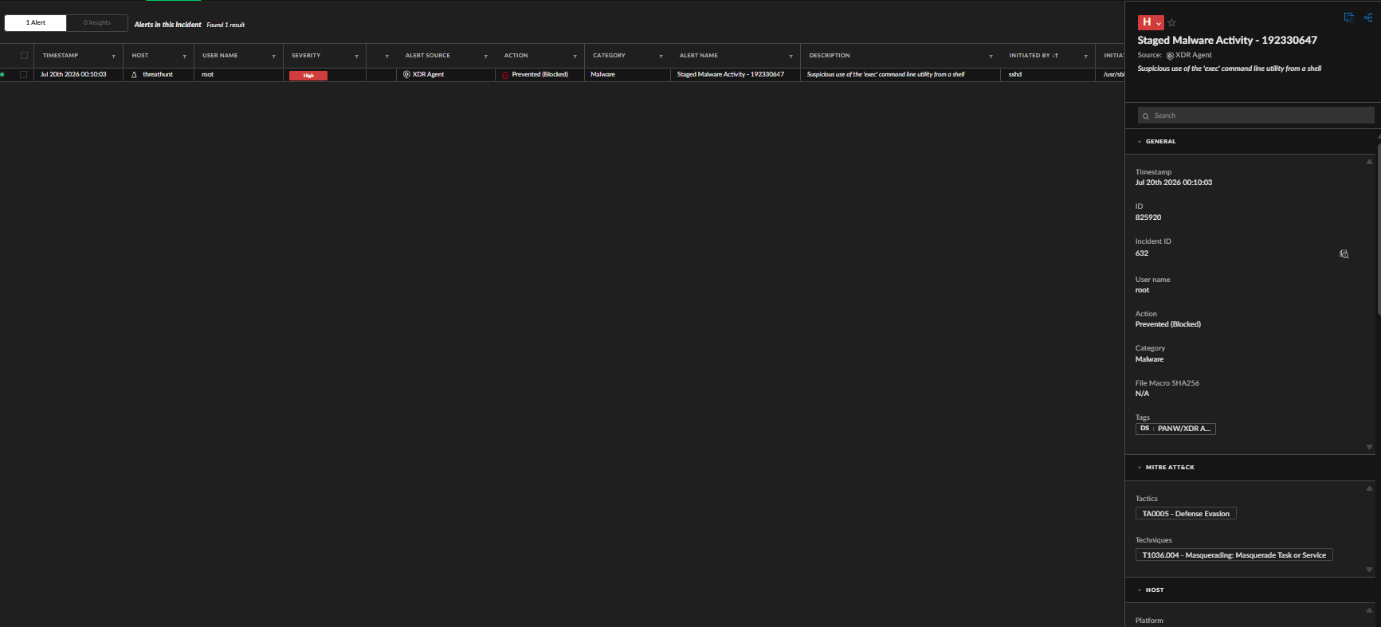
The exec -a command attempting to launch a fake kernel thread was blocked before the target process (Target Process) was spawned; that is why the "Target Process" field remained empty — an indicator not of a delayed detection but of a prevented one.
This detection was produced by Cortex XDR's Behavioral Threat Protection module independently of the custom BIOC rules shared below.
Cortex XDR Rule Recommendations
BIOC 1 — Shell Spawned from Web Server User
MITRE: T1059.004Phase: Post-ExploitationSeverity: CriticalAction: Prevent
The most direct evidence of RCE. php-fpm or nginx normally do not invoke bash, curl, or python. This behavior directly demonstrates the last link of the exploit (code execution).

BIOC 2 — PHP File Written Under wp-content/uploads
MITRE: T1505.003Phase: PersistenceSeverity: CriticalAction: Prevent
WordPress's uploads/ directory is only for static files such as images or PDFs. Any .php file written here, whatever its name, is a webshell drop. Independent of a filename-based IOC approach, it is caught even if the attacker renames the file.

BIOC 3 — Fake Process Disguised as a Kernel Thread
MITRE: T1036.005Phase: Defense EvasionSeverity: CriticalAction: Prevent
Real [kworker/x:y] kernel threads have no command line, only a name. If a command line is present, the process is definitively malicious. This is a classic concealment technique of WP-Shellstorm and similar WordPress compromise campaigns; the false-positive rate is close to zero.

BIOC 4 — Known Webshell Name Signatures
MITRE: T1505.003Phase: PersistenceSeverity: HighAction: Prevent
Campaign IOCs for wp2shell and WP-Shellstorm as reported in the industry. A fast complement to BIOC 2 (path-based); it catches known signatures instantly and triggers even without a path filter.

BIOC 5 — C2 Connection from Web Process to External Network
MITRE: T1071.001Phase: Command & ControlSeverity: HighAction: Detect (Prevent after baseline)
After compromise, a webshell frequently pulls additional payloads or opens a C2 beacon. Private IP ranges are excluded; remaining outbound connections mean traffic going to the external network. Exceptions may be needed for tools such as WordPress automatic updates or wp-cli, so it should first be launched in Detect mode.
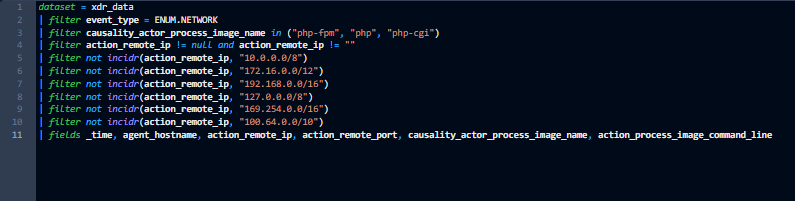
Retrospective Hunt — The "Did Someone Already Get In?" Question
BIOCs provide a defense layer for everything from today onwards. The vulnerability was disclosed on July 17 — but on which endpoints in the environment was this URL trace left in the days before that date? Because the Cortex XDR Linux agent cannot directly see HTTP URLs on the endpoint side, the retrospective hunt is carried out over DNS queries. The query below lists DNS queries made by web server processes to the external network; when run over a Last 30 days range in XQL Search, it performs a look-back scan. If a list of known C2 domains is available, it can be filtered with dns_query_name in (...).

Rule Summary Table
Starting BIOCs 1, 3, and 4 directly in Prevent can be considered; their FP profile is low and they cover high-confidence malicious behaviors. For BIOC 2 and 5, Detect mode is recommended first; defining exceptions for WordPress automatic updates, shared-hosting deploys, or wp-cli cron runs will be useful. After a 7-day baseline observation, switching them to Prevent can be considered.
Recommended Steps
High Priority
Producing a full inventory of WordPress assets and identifying their versions via WPScan, wp core version, HTTP headers, or readme.html is recommended. Treating assets in the 6.9.x and 7.0.x bands as "suspect until patched" would be appropriate.
Adding a blocking rule on the WAF or Nginx side for /wp-json/batch/v1, rest_route=/batch/v1, and the encoded variant rest_route=%2Fbatch%2Fv1 is recommended. In environments without a legitimate batch API integration, a direct return 403 approach can be considered.
Writing BIOC rules on Cortex XDR in Prevent and Detect modes is recommended. High-confidence rules can go directly to Prevent, while rules with false-positive potential can run in Detect mode until baseline observation is complete.
Running the retrospective hunt query over the last 30 days in XQL Search will be useful. If matches are found, moving to the IR playbook is recommended.
Medium Priority
Upgrading WordPress assets to versions 6.9.5 / 7.0.2 / 7.1 Beta 2 and verifying that the auto-update channel has actually been applied is recommended.
Disabling PHP execution under wp-content/uploads/ at the Nginx/Apache level can provide a second defense layer that blocks execution even if a webshell is dropped.
Enabling a persistent object cache (Redis or Memcached) can be considered as an additional layer that narrows the vulnerable code path.
Monitoring the web root with FIM (file integrity monitoring) can be useful. In particular, wp-config.php, .htaccess, and the wp-content/mu-plugins/ directories are of critical importance.
If a Finding Occurs — IR Playbook
When the hunt query or a BIOC produces a match, the standard IR flow is:
- Isolate: Cut the affected host off the network via Cortex XDR; stop the Apache/Nginx service.
- Collect artifacts:
wp-content/uploads,wp-content/plugins,wp-content/mu-plugins,.htaccess,wp-config.php, and the last 30 days of Apache access logs should be collected. - Credential rotation: DB credentials, WordPress
SECURE_AUTH_KEY/NONCE_KEYsalts, admin passwords, and API tokens should be rotated; newly created suspicious admin accounts should be deleted. - Persistence cleanup: Fake mu-plugins, cron jobs (the
cronserialized field insidewp_options),_transient_*keys, and core files changed in the last 30 days should be reviewed. - Retrospective expansion: DNS queries made to C2 domains under the same web server process tree, and traces of lateral movement (SSH, DB connections), should be scanned.
- Rebuild: If server integrity cannot be reliably verified, the server should be rebuilt from a clean image; before restoring from backups, it should be verified that the backup predates the vulnerability window.
Conclusion
CVE-2026-63030 "wp2shell" is one of the most critical vulnerabilities the WordPress ecosystem has faced in recent years. The pre-auth + core + RCE trifecta offers attackers an internet-scale automation opportunity. Applying the patch stands out as the first and most important layer; however, the patch does not evict anyone who has already gotten in, so deploying retrospective hunts and behavioral EDR/XDR rules in parallel is recommended.
When the five BIOCs plus one hunt query above are deployed in a Cortex XDR environment, they form a comprehensive defense layer capable of catching every stage of wp2shell's kill chain. Because behaviors such as a suspicious process spawning from the web server user or PHP being written into a web directory are independent of the exploit's internal details, the same rules will also protect against future WordPress RCEs beyond wp2shell.
Ömer Kaan Kurt - L1 MDR Analyst
InfinitumIT MDR - Detection Engineering & Threat Hunting
This post is based on behavioral detection principles applied in real EDR/XDR environments. Before taking the rules into production use, environment-specific exception baselines should be established.